New Product

Organizations have spent decades improving how incidents are reported, investigated, documented, and tracked. EHS platforms have made it easier to standardize workflows, assign investigations, manage corrective actions, and maintain records across increasingly complex operations.
But one important question has remained surprisingly difficult to answer at scale: How good was the investigation?
An investigation can be completed on time, include all of the required fields, and move successfully through an approval workflow while still missing important evidence, overlooking causal factors, reaching conclusions that are not fully supported, or recommending corrective actions that do not address the underlying conditions that produced the event.
That distinction matters because the value of an investigation is not determined by whether the report was completed. It is determined by whether the organization learned the right lessons from the event and translated those lessons into meaningful risk reduction.
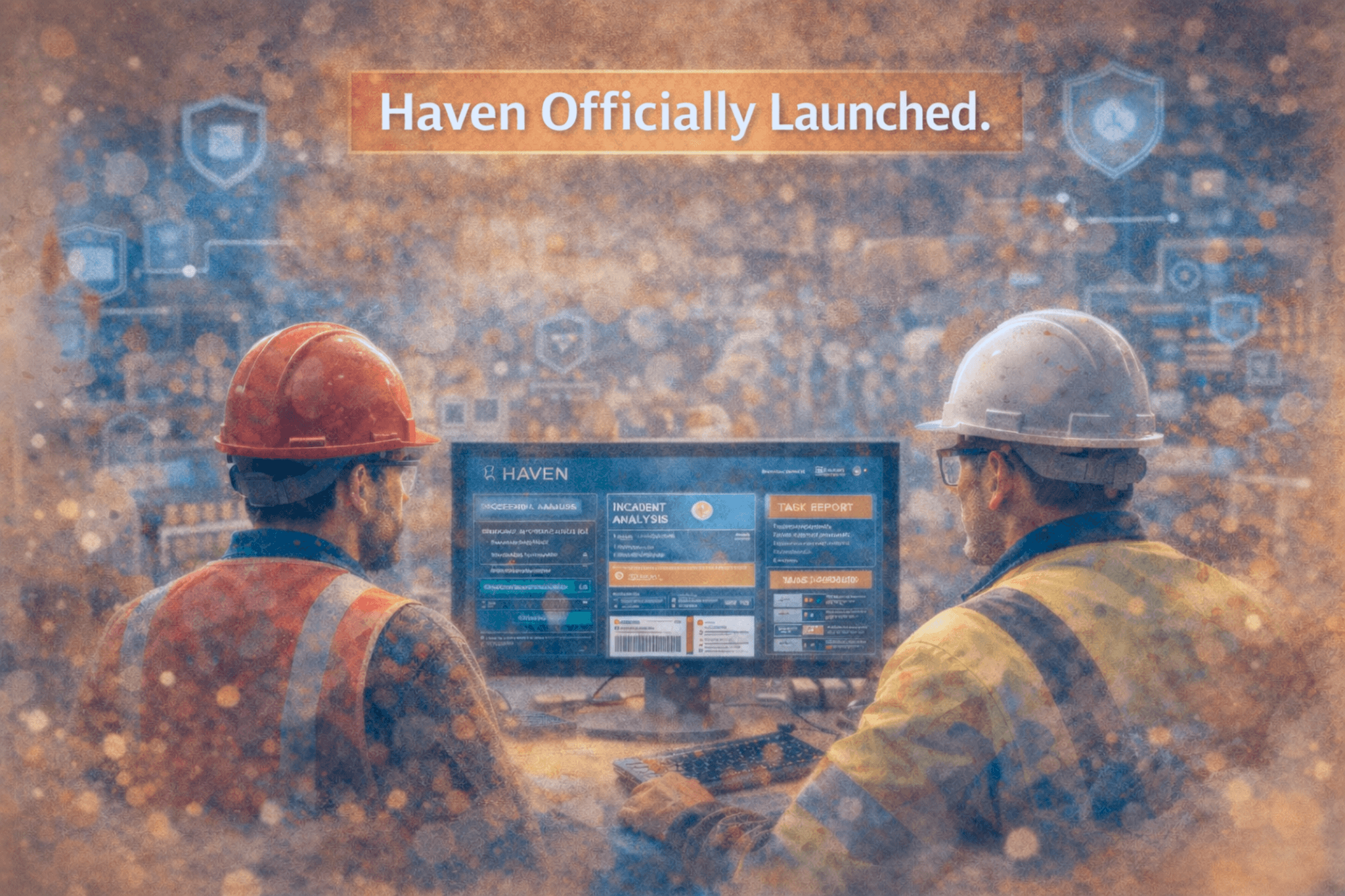
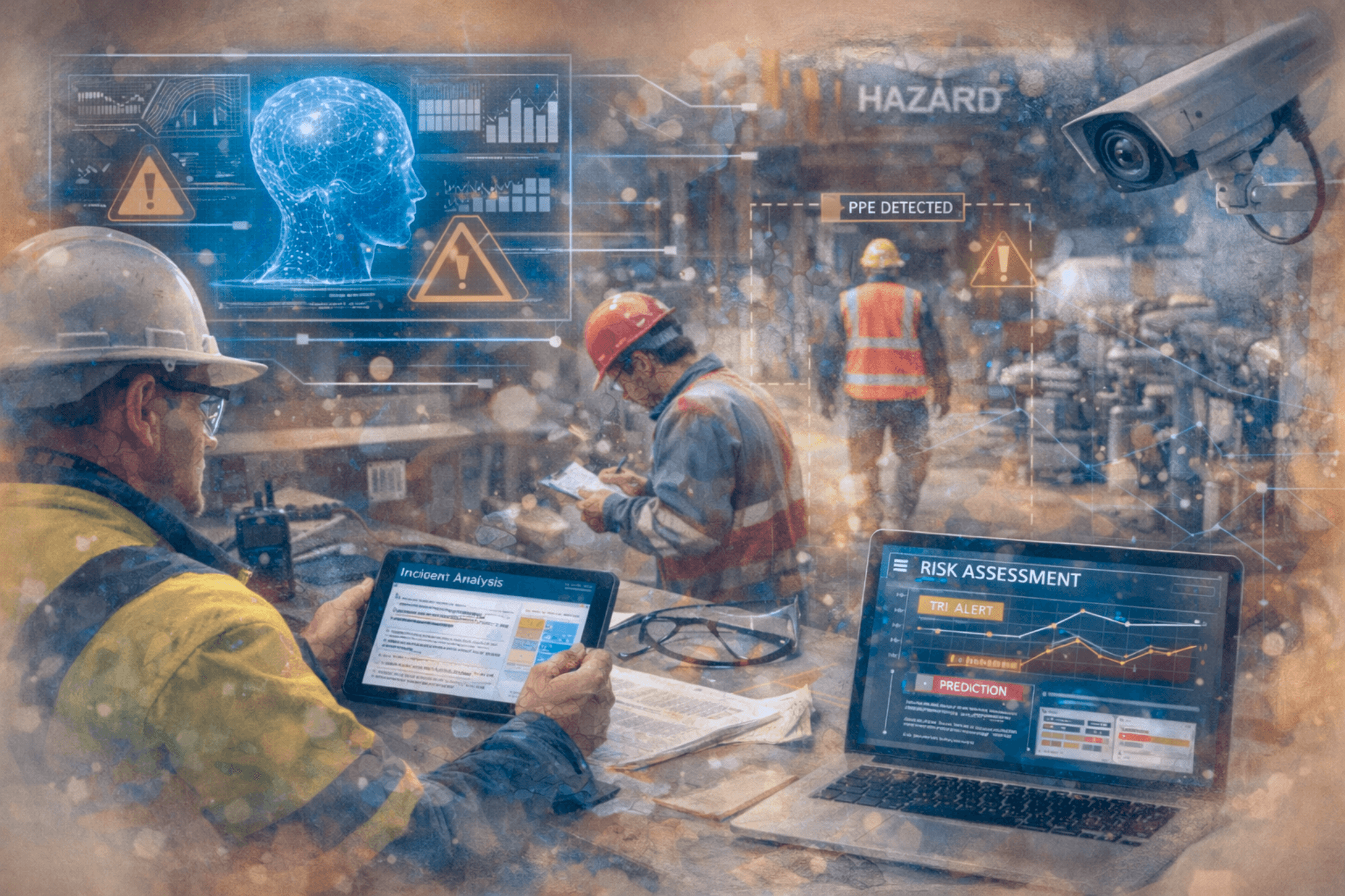
Today, we are introducing HavenASSURE, a new capability within Haven Safety AI designed to help organizations systematically evaluate and improve the quality of completed incident investigations.
Investigation quality is difficult to manage at scale
Most mature safety organizations already have some form of investigation quality assurance. Experienced safety leaders review major events, investigation teams conduct peer reviews, corporate EHS groups perform audits, and some organizations periodically sample completed investigations to assess consistency and rigor.
These approaches are valuable, but they are also constrained by time and expertise. A senior safety professional may be able to perform a detailed review of a handful of investigations each month. They cannot realistically apply that same level of scrutiny to hundreds or thousands of investigations distributed across sites, business units, contractors, and geographies.
As a result, investigation quality can vary substantially depending on who conducted the investigation, how much time was available, what evidence was collected, and how much experience the investigator brought to the process.
That creates an important blind spot. Organizations can measure how many investigations were completed, how quickly they were closed, and whether corrective actions were assigned, while having far less visibility into whether the underlying analysis was actually complete and defensible.
HavenASSURE is designed to help close that gap by making investigation quality something organizations can evaluate more consistently and at much greater scale.
Why simply asking AI to "grade" an investigation is not enough
Generative AI creates an obvious opportunity for investigation review. Give a large language model an investigation report and ask whether it is good, and it can produce a plausible assessment almost immediately.
But in safety-critical work, a plausible answer is not necessarily a useful one.
A generic AI model does not inherently know how a particular organization expects investigations to be conducted. It may not understand the company's investigation methodology, required evidence, internal procedures, control environment, terminology, or expectations for causal analysis and corrective actions. It also does not inherently understand how the specific hazards, tasks, controls, equipment, failure modes, and causal factors within an event relate to one another.
Without that context, AI risks becoming an arbitrary judge of the investigation rather than a useful quality assurance tool.
HavenASSURE takes a different approach. Instead of relying solely on the general knowledge contained in a foundation model, ASSURE grounds its analysis in Haven's structured safety knowledge graph and the organization's own investigation requirements and operating context.
Haven's knowledge graph connects the concepts that matter in safety investigations, including hazards, exposures, controls, tasks, equipment, failure modes, causal factors, procedures, corrective actions, and prior events. This gives the AI a structured domain model against which it can reason rather than treating an investigation as simply another piece of text.
Organizations can then layer their own investigation standards, procedures, methodologies, and requirements into that context. The resulting assessment is therefore not simply based on whether an AI model believes an investigation "looks good." It is based on whether the investigation is complete and well supported given the available evidence, relevant safety knowledge, and the standards against which that organization expects its investigations to be conducted.
What HavenASSURE evaluates
HavenASSURE acts as an additional quality assurance layer over completed investigations. It reviews the investigation record and looks for areas that deserve additional scrutiny before the investigation is finalized or its findings are incorporated into broader organizational learning.
Depending on the investigation and the organization's requirements, this can include evaluating evidence completeness, identifying unresolved contradictions, assessing timeline integrity, looking for causal factors that may have been overlooked, examining whether root cause conclusions are adequately supported, and evaluating whether corrective actions logically address the identified causes.
ASSURE can also examine areas such as witness coverage, procedures, training, PPE, equipment, environmental conditions, human factors, and the strength of corrective actions relative to the Hierarchy of Controls.
The objective is not to have AI replace the investigator or make the final safety decision. The objective is to give investigators and safety leaders another structured, evidence-informed review of the work so they can decide whether additional investigation, evidence, analysis, or corrective action is needed.
This distinction is important. In high-consequence safety work, professional judgment and accountability should remain with the people responsible for the investigation. AI is most useful when it improves the information available to those professionals and helps them apply greater rigor and consistency to the decisions they make.
From sampling investigations to assuring investigations
One of the most significant opportunities with this approach is scale.
Historically, detailed investigation quality reviews have often been reserved for the most serious incidents or performed on a sample of completed investigations because experienced reviewers are a scarce resource. AI changes that constraint.
Instead of asking senior safety professionals to manually review every investigation, organizations can use ASSURE as a first layer of quality assessment across a much larger percentage of their investigation portfolio. Human experts can then focus their attention where it adds the most value: reviewing meaningful gaps, resolving ambiguous findings, coaching investigators, and scrutinizing higher-risk events.
This creates the opportunity to move from periodic quality sampling toward a much more systematic model of investigation assurance.
It also gives organizations a way to begin measuring investigation quality itself. Over time, safety leaders can identify where particular investigation teams consistently perform well, where evidence gaps frequently occur, which causal factors are routinely missed, or where corrective actions repeatedly fall toward the weaker end of the Hierarchy of Controls.
Investigation quality can become something organizations actively manage and improve rather than something they infer from completed reports.
Better investigations create better organizational learning
There is a broader reason we believe investigation assurance matters.
Every completed investigation contributes, formally or informally, to an organization's institutional knowledge. Investigation findings influence corrective actions, procedures, training, risk assessments, leadership decisions, and eventually how the organization understands patterns across incidents.
If the underlying investigations are incomplete or their conclusions are weak, those weaknesses propagate into the learning system.
An overlooked causal factor can lead to an ineffective corrective action. An unsupported conclusion can become an accepted explanation for similar events. A weak investigation can be grouped with hundreds of other investigations and influence trend analysis or emerging AI systems that assume the underlying records are accurate.
As organizations increasingly use AI to identify patterns across large volumes of safety information, the quality of the information entering that learning system becomes even more important.
This is why we see investigation quality assurance as a natural part of Haven's broader learning architecture. Haven helps organizations capture richer evidence, conduct more rigorous investigations, evaluate the quality of those investigations, and then connect what was learned across incidents, sites, and business units.
In that model, ASSURE serves an important role between investigation and organizational learning. Before an investigation contributes to what the organization believes it knows, ASSURE helps determine whether the analysis behind those conclusions is sufficiently complete, consistent, and well supported.
Building a stronger learning loop
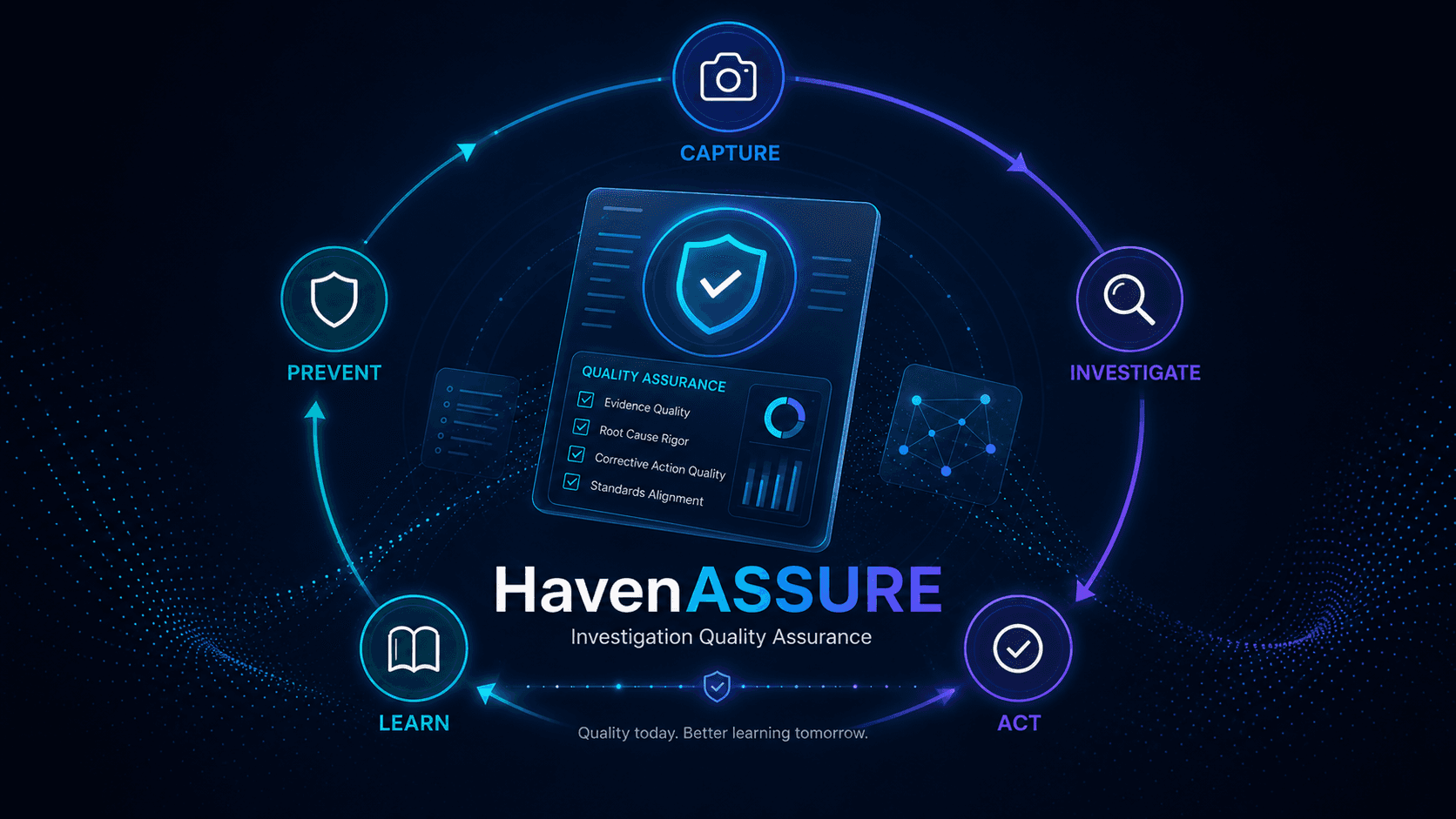
We have consistently argued that the real opportunity for AI in safety goes well beyond making existing administrative work faster. The larger opportunity is to help organizations improve the quality and consistency of how they investigate, reason, learn, and ultimately prevent recurrence.
HavenASSURE extends that philosophy into investigation quality assurance.
By combining AI reasoning, structured safety knowledge, company-specific investigation requirements, and the evidence contained within each event, organizations can apply a level of quality review that historically has been difficult to achieve consistently at enterprise scale.
The result is not AI replacing human judgment. It is AI helping safety professionals apply that judgment with better context, greater consistency, and more complete information.
And ultimately, that is what investigation quality should be about: making sure that the lessons an organization carries forward are lessons it can trust.




Experimenta cómo la inteligencia de seguridad potenciada por IA puede transformar tu lugar de trabajo. Reserva una demostración para ver nuestra plataforma en acción.