Pro Tips
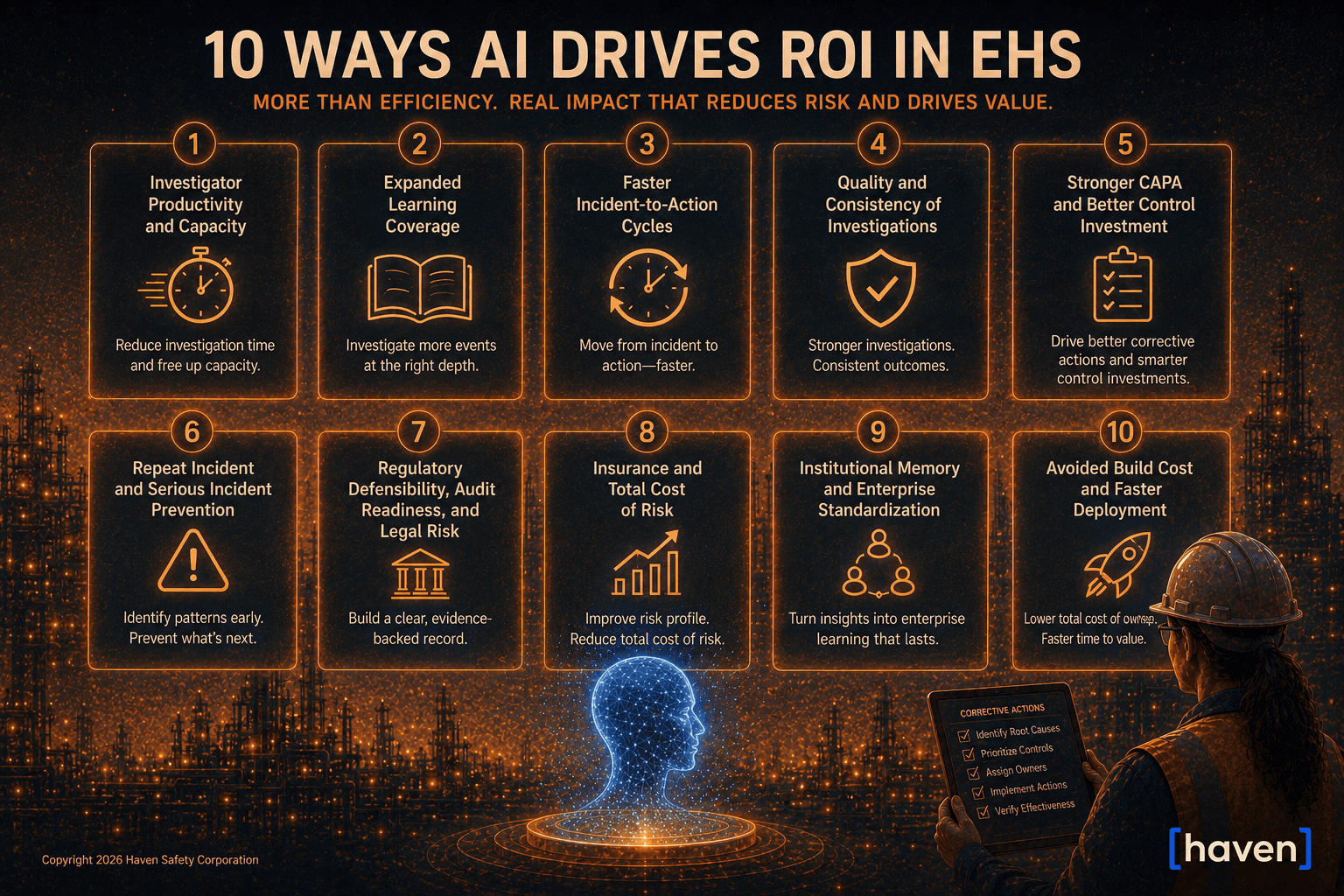
The ROI Case for AI in EHS: From Efficiency Gains to Risk Intelligence
EHS leaders are under pressure from every direction.
They are expected to manage more incidents, more data, more contractor complexity, more compliance obligations, and more executive scrutiny, often without proportional increases in headcount or budget. At the same time, safety leaders are being asked to do more than document what happened. They are being asked to prevent what happens next.
That is where AI can change the operating model.
The business case for AI in EHS should not be framed only as “saving time.” Time savings matter, and they are often the first measurable return. But the stronger case is that AI gives EHS teams a scalable investigation, learning, and prevention layer. It helps teams move faster, analyze more consistently, identify repeat patterns, strengthen corrective actions, and create a more defensible record of how risk is being managed.
In other words, the ROI is not just productivity. It is risk-adjusted operating leverage.
Below are ten categories EHS leaders can use to build the business case for AI applications in safety, incident investigation, root cause analysis, corrective action management, and enterprise risk learning.
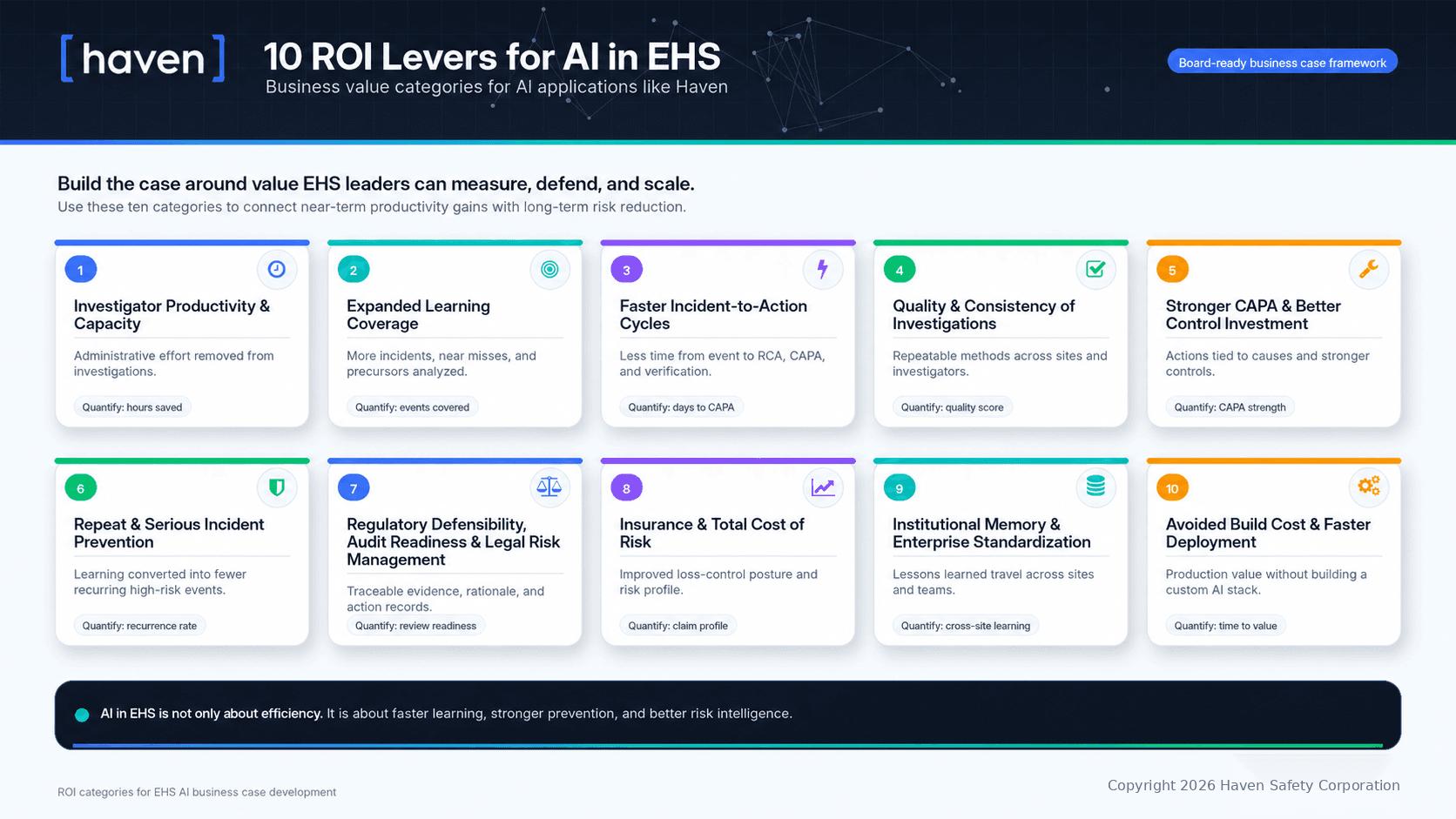
1. Investigator productivity and capacity
The most immediate ROI category is time.
Incident investigations require investigators to gather evidence, interview witnesses, reconstruct timelines, review documents, organize photos and videos, draft narratives, perform root cause analysis, and develop corrective actions. Much of this work is manual. Much of it is repetitive. And much of it happens when the organization is already under pressure to respond quickly.
AI can reduce the administrative burden of investigations by helping structure evidence, summarize inputs, flag gaps, draft investigation-ready narratives, and organize analysis for human review.
This does not remove the safety professional from the process. It gives them a stronger starting point.
How to quantify it:
Measure the number of investigations completed, the baseline hours per investigation, the loaded labor rate of the people involved, and the expected reduction in investigation effort.
A simple model:
Number of investigations × baseline investigation hours × loaded labor rate × expected time reduction
This can also include reduced overtime, reduced external consulting spend, less time spent by operations leaders supporting investigations, and fewer delayed closeouts.
2. Expanded learning coverage
The second ROI category is investigation coverage.
Many organizations reserve full root cause analysis for the most serious events. That makes sense when investigation capacity is limited. But it also means near misses, lower-severity incidents, contractor events, and precursor events are often under-analyzed.
That is a problem because serious events rarely appear out of nowhere. They are often preceded by weaker signals that were visible, but not fully investigated.
AI changes the economics of learning. When investigations take less time and can be performed more consistently, teams can analyze more events at the right level of depth. That means the organization learns not only from serious injuries and high-potential events, but also from the smaller events that point to emerging exposure.
How to quantify it:
Track the number of events investigated before and after implementation, segmented by severity, potential severity, location, contractor involvement, and event type.
Useful measures include:
Increase in investigations completedPercentage of near misses investigated at the right depthNumber of precursor events converted into learningInvestigation coverage by site or business unit
The business case here is simple: AI allows EHS teams to learn from more of the data they already have.
3. Faster incident-to-action cycles
Speed matters in safety.
When an incident occurs, the clock starts. The organization needs to understand what happened, identify immediate controls, determine root causes, assign corrective actions, and verify that risk has been reduced. Delays keep exposure in place.
AI can compress the time between incident, evidence capture, causal analysis, corrective action assignment, and operational learning. The value is not just that the report gets done faster. The value is that risk controls can be implemented sooner.
How to quantify it:
Measure median cycle time at each stage of the incident process.
Key metrics include:
Days from incident to evidence package completeDays from incident to RCA completeDays from incident to corrective action assignmentDays from incident to interim controlDays from incident to corrective action completionDays from incident to verification of effectiveness
This category is especially important in high-risk operations where every day of delay can mean continued exposure to the same hazard.
4. Quality and consistency of investigations
Faster investigations only create value if they are better investigations.
Traditional investigations often vary by site, investigator experience, available evidence, workload, and local practices. That variability creates risk. One site may perform a rigorous root cause analysis while another produces a shallow narrative and a corrective action that defaults to retraining.
AI can help standardize the investigation process. It can prompt for missing evidence, surface conflicting information, apply consistent causal analysis methods, and help ensure that findings are grounded in the record.
This is where the business case moves beyond productivity. AI can improve the quality and consistency of the safety operating model.
How to quantify it:
Create an investigation quality scorecard.
Score investigations on criteria such as:
Evidence completenessTimeline qualityWitness coverageCausal depthConsideration of human and organizational factorsStrength of corrective actionsTraceability from evidence to conclusionsVerification plan quality
Then compare quality scores before and after implementation by site, business unit, investigator, and incident type.
The goal is not simply more reports. The goal is more prevention-grade investigations.
5. Stronger CAPA and better control investment
Corrective actions are where investigation work turns into risk reduction.
But not all corrective actions are equal. Some reduce exposure. Others create activity without changing risk. A corrective action that says “retrain employees” may be appropriate in some cases, but it is often overused because it is easy to assign and easy to close.
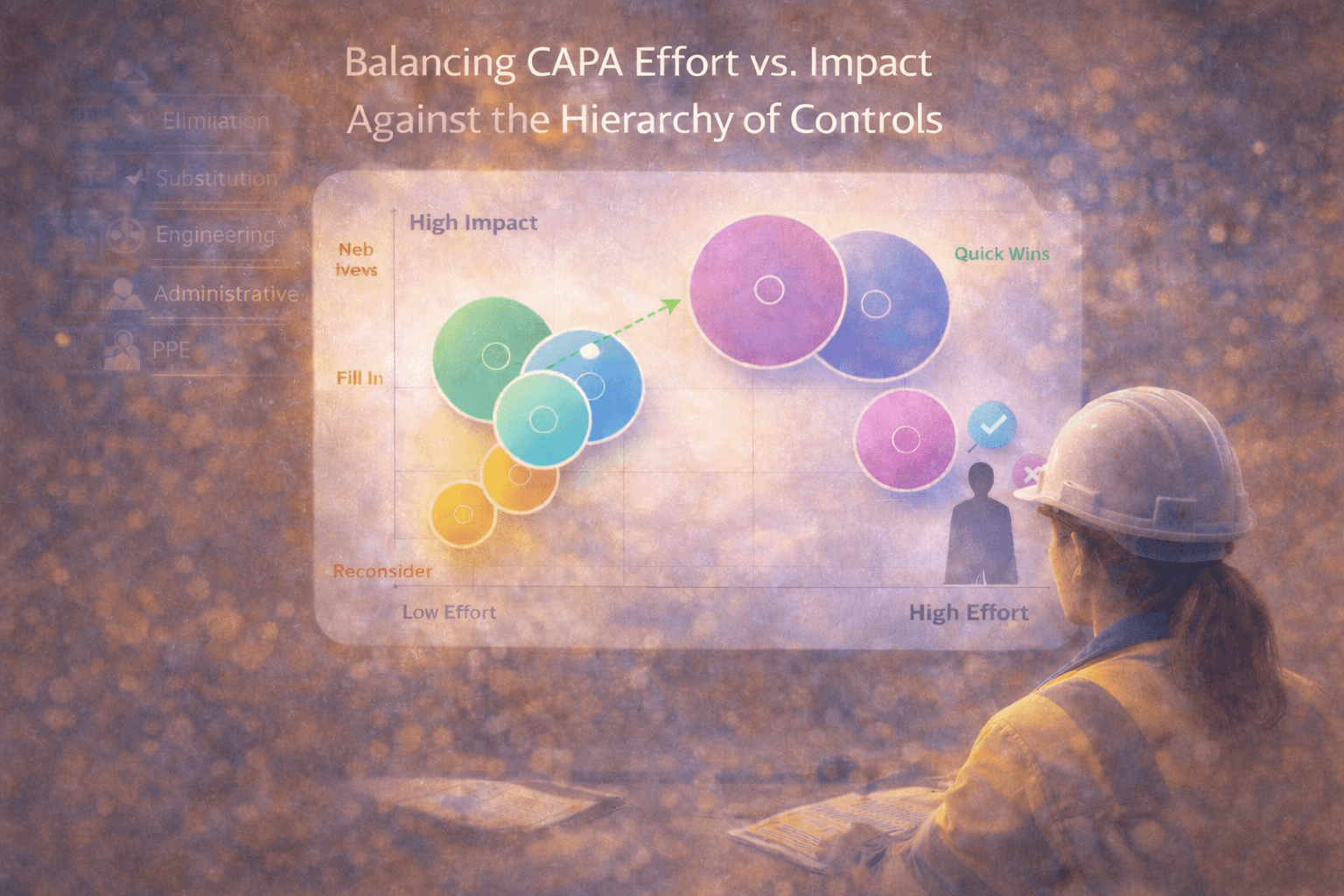
AI can help teams develop more practical, higher-quality CAPA by connecting actions back to root causes, comparing similar events, assessing effort and expected impact, and supporting alignment with the hierarchy of controls.
The value is not more corrective actions. The value is better corrective actions.
How to quantify it:
Track the quality, strength, and effectiveness of CAPA.
Useful measures include:
Percentage of corrective actions tied directly to root causesPercentage of corrective actions aligned to higher-order controlsCorrective action completion rateCorrective action overdue rateVerification of effectiveness completion rateRepeat events after corrective action closureCAPA cost compared with expected risk reduction
This is also where AI can help avoid waste. Poor CAPA consumes time, budget, and credibility without reducing exposure.
6. Repeat incident and serious incident prevention
This is the largest value pool, but it should be modeled carefully.
AI should not be sold as a magic tool that guarantees incident reduction. Safety outcomes are influenced by leadership, operations, culture, controls, contractor management, work design, and many other factors.
But AI can strengthen the mechanisms that prevent repeat incidents: better evidence capture, stronger causal analysis, faster corrective actions, improved trend detection, and more consistent learning across the enterprise.
Many organizations look for repeat events after injuries, recordables, or serious incidents occur. The stronger opportunity is to detect patterns earlier, including near misses, high-potential events, and corrective action history. If the same guard is bypassed, the same procedure is unclear, the same contractor task is creating exposure, or the same control keeps appearing in near misses, that is a risk signal.
How to quantify it:
Use conservative scenarios.
For example:
Baseline repeat failed controls × estimated exposure cost × expected reduction scenario
Or:
Baseline near misses and serious incident precursors × expected reduction scenario × estimated exposure cost
Other useful measures include:
Repeat failed controls by site, task, contractor, or asset
Percentage of near misses linked to known control weaknesses
Repeat events/control failure after corrective action closure
High-potential near miss rate
Time from repeated control failure detection to corrective action assignment
Time from corrective action closure to verification of control effectiveness
Model low, medium, and high scenarios. Keep the assumptions transparent.
For high-risk organizations, even a small reduction in repeat events, serious injuries, high-potential incidents, or operational disruptions can create significant financial and human value.
7. Regulatory defensibility, audit readiness, and legal risk management
EHS work is not only about doing the right thing. It is also about being able to show what was done, why it was done, and how decisions were made.
When regulators, auditors, insurers, or legal teams review an incident, they often look beyond whether the incident was recorded. They look at how rigorously it was investigated, whether root causes were supported by evidence, whether corrective actions were appropriate, and whether the organization followed through.
AI can strengthen defensibility by creating a clearer connection between evidence, analysis, decisions, and actions. But this only works when AI is governed properly. AI should support professional judgment, not replace it. Draft outputs should remain separate from approved findings. Human review and approval should remain central.
How to quantify it:
Measure documentation quality, response readiness, and rework.
Useful measures include:
Time to prepare investigation records for audit or legal reviewNumber of investigation reports requiring reworkAudit findings related to incident management or CAPARegulatory response cycle timePercentage of findings traceable to source evidencePercentage of CAPA decisions with documented rationale
This category matters because AI can create a more complete record. The business case should show that the organization is not only adopting AI, but governing it responsibly.
8. Insurance and total cost of risk
The insurance case usually develops over a longer horizon, but it should be part of the ROI model.
Better investigations, faster corrective actions, stronger documentation, and fewer repeat events can improve the organization’s risk profile. That may influence claim frequency, claim severity, reserves, deductibles, self-insured losses, and insurer confidence.
For many companies, the strongest internal partner for this part of the case will be risk management, finance, or insurance.
How to quantify it:
Work with the risk or finance team to connect AI-enabled safety improvements to the company’s total cost of risk model.
Potential measures include:
Workers’ compensation claim frequencyAverage claim costHigh-severity claim historyOpen reservesSelf-insured lossesPremium trendsExperience modification rate where applicableBroker or insurer feedback
This should not be oversold as an immediate premium reduction. It is better framed as a stronger loss-control posture and a more credible risk management story.
9. Institutional memory and enterprise standardization
Many safety organizations struggle with institutional memory.
Lessons learned stay local. Investigation quality varies by site. Corrective actions are not always compared across similar events. Contractor incidents may be treated differently from employee incidents. New investigators need time to build experience. And when experienced safety leaders leave, their judgment often leaves with them.
AI can help convert investigations into an enterprise learning system. It can support common taxonomies, standard methods, comparable findings, and cross-site pattern recognition. It can also help new investigators operate with more structure and consistency.
This is a strategic ROI category because it changes how the organization learns.
How to quantify it:
Track standardization and knowledge transfer.
Useful measures include:
Investigation quality variance by siteConsistency of causal factor classificationRepeat root causes across sitesCross-site corrective actions generated from similar eventsTime for new investigators to reach proficiencyPercentage of investigations using standard methodologyNumber of enterprise-level risk themes surfaced
This is the difference between isolated incident files and connected risk intelligence.
10. Avoided build cost and faster deployment
The last ROI category is the build-versus-buy case.
Internal AI prototypes can be impressive. But production EHS AI is not just a model. It requires domain structure, workflow design, data security, privacy controls, evidence grounding, auditability, user permissions, evaluation, integrations, change management, and long-term maintenance.
For safety-critical workflows, the lifecycle cost matters more than the initial prototype cost.
A purpose-built AI application can accelerate time to value because the domain logic, workflow, controls, and evaluation methods are already built for the EHS context.
How to quantify it:
Compare vendor investment against the full internal cost of ownership.
Include:
Product managementData engineeringSoftware engineeringAI model evaluationSecurity and privacy reviewWorkflow designIntegrationsOngoing maintenanceUser supportChange managementOpportunity cost of delayed deployment
The question is not, “Can we build a prototype?” The question is, “Can we build, govern, maintain, improve, and scale a production-grade EHS AI system faster and more economically than buying one?”
Building the ROI case across three horizons
The strongest business case connects near-term financial value with longer-term risk reduction.
In the first 90 days, the case is about efficiency, investigation capacity, evidence quality, and consistency. This is where teams can usually measure time saved, coverage expanded, and cycle time improved.
From two to six months, the case becomes more operational. AI should begin improving corrective action quality, incident-to-action speed, cross-site learning, and visibility into recurring risk themes.
From six to eighteen months, the case becomes strategic. The organization can begin connecting AI-enabled learning to fewer repeat events, stronger regulatory defensibility, improved insurance conversations, and a more mature safety operating model.
The bigger point
AI in EHS should not be positioned as a replacement for safety professionals.
That misses the point and creates unnecessary resistance.
The better framing is this: AI gives safety professionals a scalable co-pilot for investigation, analysis, corrective action, and organizational learning. It helps teams capture what might otherwise be missed, move from documentation to prevention, and make better use of the data already sitting inside incident reports, photos, videos, witness statements, audits, observations, and corrective action systems.
The ROI case is not just that AI helps EHS teams work faster.
It is that AI helps EHS teams learn faster.
And in safety, learning faster is one of the clearest paths to reducing risk.


Experimenta cómo la inteligencia de seguridad potenciada por IA puede transformar tu lugar de trabajo. Reserva una demostración para ver nuestra plataforma en acción.