
NAEM Publishes Landmark Research on AI in EHS and Sustainability, Sponsored by Haven Safety AI
New report highlights how AI is reshaping safety, risk management, and operational decision-making across global enterprises
Artificial intelligence is quickly becoming part of the EHS and sustainability operating model.
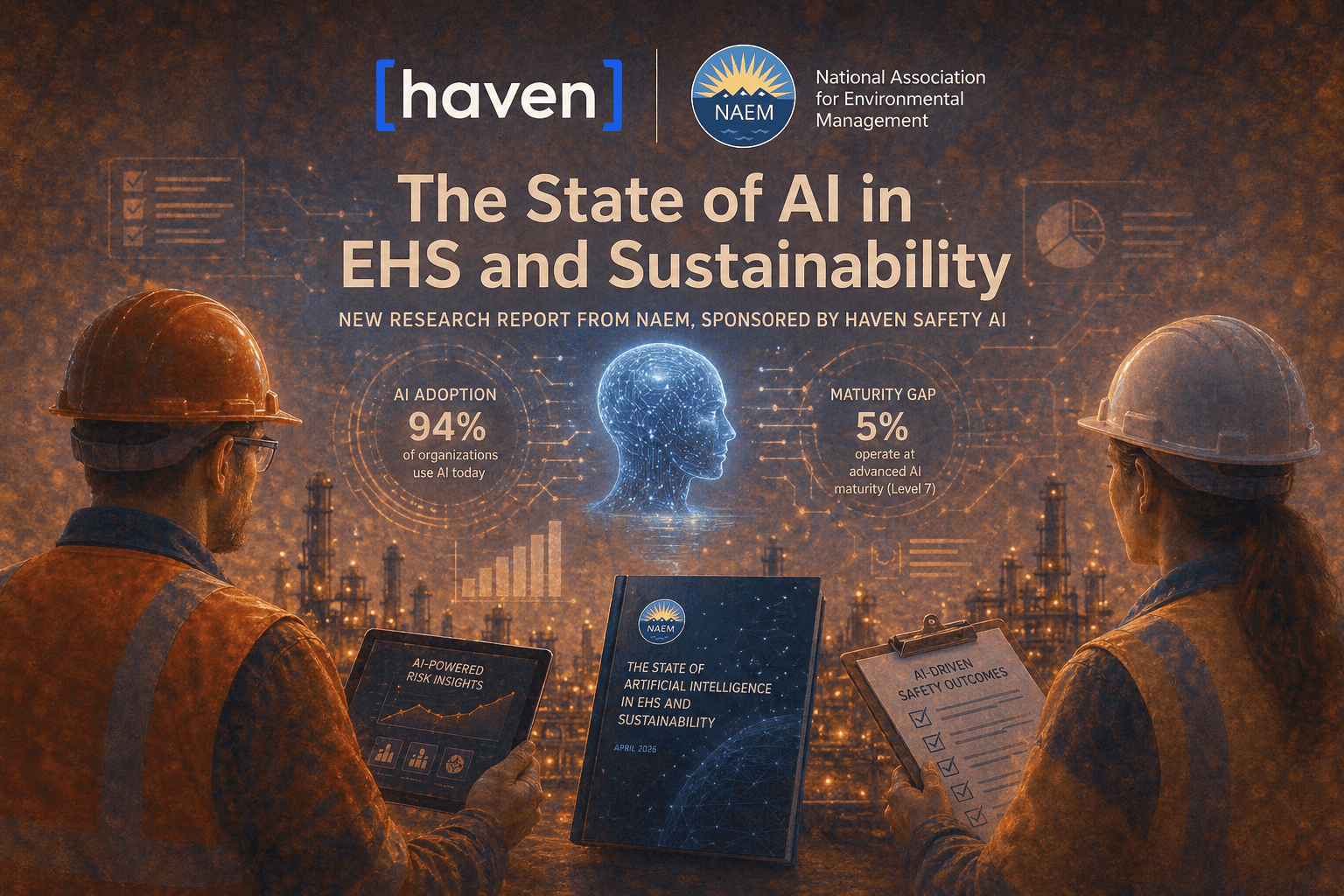
Haven Safety AI is proud to sponsor a new industry research report from the National Association for Environmental Management, titled “The State of Artificial Intelligence in EHS and Sustainability.” Published in April 2026, the report provides a research-based look at how AI is being adopted across Environment, Health, Safety, and Sustainability functions, including current use cases, adoption drivers, implementation challenges, and the readiness steps organizations are taking as AI becomes more embedded in day-to-day work.
The report draws on input from 109 companies and includes qualitative interviews with 12 EHS&S AI experts, offering a practical benchmark for leaders navigating AI adoption in regulated, risk-sensitive environments.
One of the clearest findings: AI is no longer a future-state concept for EHS and sustainability teams. According to the report, only 5% of respondents in NAEM’s 2019 research reported that their company used AI tools. Today, that number has risen to 94%. That shift reflects how quickly AI has moved from emerging technology to accessible workplace capability.
At the same time, the report shows that most organizations are still early in the maturity curve. While 94% of respondents reported using AI for Level 1 activities such as background research, only 5% reported participating in Level 7 activities, where AI is treated as a strategic capability supporting proactive, adaptive risk management through real-time sensing, automation, and continuous learning.
That gap is important. It shows that while AI adoption is widespread, mature and governed use of AI in EHS&S is still developing.
AI is already changing how EHS teams work
The report finds that today’s most common AI applications are practical, productivity-focused use cases. Respondents most frequently reported using AI to search for information, summarize regulations or documents, analyze data for key points, and draft policies, procedures, or training materials.
These early use cases matter because they address a persistent challenge for EHS&S teams: growing workloads, fragmented data, and limited resources. AI is helping teams move faster, synthesize information more effectively, and make existing EHS knowledge easier to access across the organization.
The report also highlights more advanced use cases beginning to emerge, including AI-assisted incident documentation, large-scale EHS data analysis, internal EHS knowledge agents, image-based hazard identification, and safety-focused decision support. These applications point toward a broader shift from reactive, manual processes to more proactive, data-driven risk management.
“This research makes one thing clear: AI is no longer a future concept in safety and sustainability. It is already reshaping how leading organizations identify risk, investigate incidents, and prevent future harm,” said Joseph Hanna, Co-Founder and CEO of Haven Safety AI. “What’s emerging is a new operating model for EHS, one that is faster, more consistent, and grounded in data. At Haven, we see this every day in how AI can augment safety teams, elevate the quality of investigations, and ultimately help organizations prevent serious incidents before they occur.”
The next phase of AI adoption will require governance, data quality, and trust
While the report shows strong momentum, it also makes clear that scaling AI responsibly is not simply a technology challenge.
Among the top barriers to more sophisticated AI adoption, respondents cited uncertainty about data privacy and sharing requirements, lack of internal expertise, and inconsistent or difficult-to-validate AI outputs. These concerns are especially important in EHS&S, where AI-generated insights may influence safety decisions, compliance workflows, incident investigations, and corrective action planning.
The report emphasizes that AI should not replace professional judgment. Instead, it should strengthen the ability of EHS and sustainability professionals to identify patterns, prioritize risk, improve documentation, and act faster where it matters most.
For organizations preparing for more advanced AI adoption, the most common readiness step was training staff on AI fundamentals, followed by upgrading software systems, implementing data governance standards, developing AI governance frameworks, and enhancing cybersecurity controls.
Together, these findings point to a practical conclusion: the organizations that will benefit most from AI are not necessarily those experimenting with the flashiest tools. They are the organizations building the foundations required for responsible, repeatable, and trusted AI use.
Why this research matters
EHS and sustainability leaders are facing increasing regulatory complexity, rising expectations for transparency, and growing pressure to improve safety outcomes with limited resources. AI is emerging as a critical capability for meeting those challenges.
But in high-consequence environments, AI must be applied with discipline. EHS teams need tools that are grounded in domain expertise, connected to approved workflows, supported by strong governance, and designed to keep humans accountable for final decisions.
“AI is rapidly becoming a critical capability for EHS and sustainability leaders,” said Carol Singer, Executive Director of NAEM. “Our research shows that organizations are not just experimenting with AI, they are beginning to integrate it into core workflows to improve decision-making, strengthen compliance, and drive better operational outcomes. This report is designed to help leaders understand where AI is delivering value today and how to approach adoption responsibly.”
For Haven Safety AI, sponsoring this research reflects a broader commitment to helping the EHS community understand where AI can create real value and how it can be implemented responsibly.
Haven’s AI-native platform helps organizations modernize incident investigations, improve root cause analysis, strengthen corrective action planning, and identify systemic risk patterns across operations. The same themes highlighted in the NAEM report, including governance, data quality, human oversight, and proactive risk reduction, are central to Haven’s approach.
As AI adoption continues to accelerate, the opportunity for EHS leaders is clear: move beyond fragmented, manual workflows and begin building a more intelligent, connected, and preventive safety operating model.
The full report, “The State of Artificial Intelligence in EHS and Sustainability,” is available through NAEM and Haven Safety AI.
About NAEM
The National Association for Environmental Management is the leading professional association for EHS and sustainability decision-makers. NAEM provides benchmarking, research, and peer-led insights to help corporate leaders advance environmental stewardship, safety performance, and operational excellence.