Pro Tips
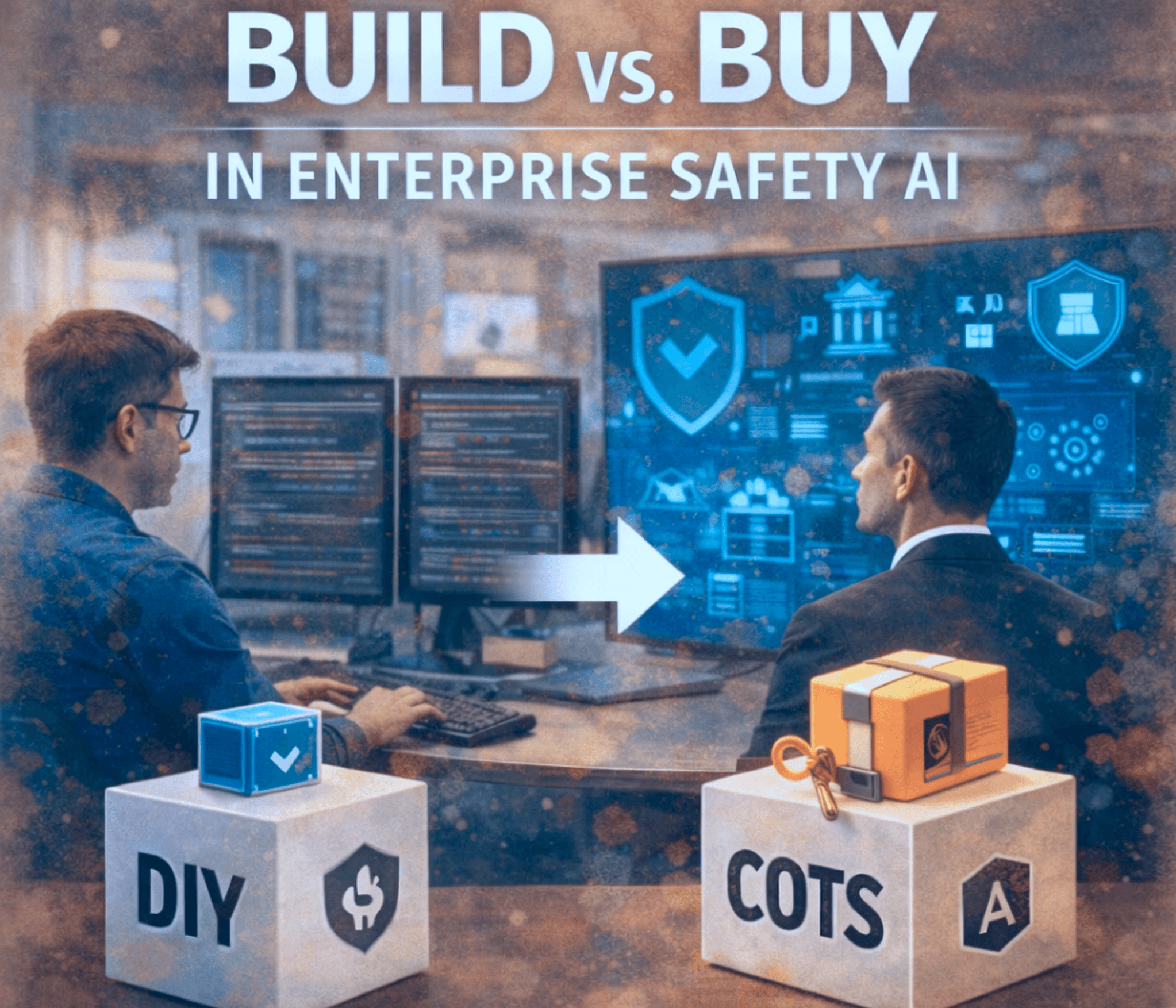
Why vertical COTS is increasingly the rational default for safety intelligence
Should you do it yourself (DIY) or leverage a Commercial Of The Shelf (COTS) package? The trend is shifting.
The first wave of enterprise generative AI adoption rewarded speed. Connect a foundation model, add retrieval, ship a pilot. In safety operations, many teams proved they could produce summaries, draft investigations, and extract key facts quickly.
Then production requirements arrived.
In high-stakes safety workflows, the hard part is not getting a model to respond. The hard part is operational trust: security, privacy, auditability, consistency, accountability, and defensibility when decisions face regulatory scrutiny, litigation risk, and real-world consequences. As foundation models commoditize and common engineering patterns converge, durable advantage moves up the stack into domain representations, evaluation and drift control, governance, and learning loops that improve over time.
The DIY iceberg nobody budgets for
Teams often underestimate why a fast prototype turns into a slow rollout. A useful way to think about it is an iceberg.
Above the waterline (what pilots cover)
Model API integration
Basic retrieval (RAG)
Prompt iteration
Prototype UI and outputs
A couple of initial connectors
This is the part that moves quickly and demos well.
Below the waterline (what production demands)
Domain-specific modeling (hazards, controls, failure modes, tasks, standards)
Grounding and traceability (what evidence supports this output?)
A real evaluation suite (regression tests, edge cases, red-teaming)
Drift monitoring (providers update models, data shifts, prompts evolve)
Workflow and audit trail (review gates, approvals, accountability)
Security and access control (RBAC, SSO, tenant isolation, logging)
Data privacy by design (retention, PII handling, policy enforcement)
Deep integrations (EHS tooling, corrective action systems, document management, training workflows)
Monitoring, support, and operational ownership (on-call, incidents, SLAs)
Ongoing maintenance (patches, compliance updates, platform migrations, connector breakage)
Talent retention and continuity (the hidden cost of turnover and re-learning)
The key point: the initial build is rarely the dominant cost. Lifecycle ownership is.
Why buying is becoming the default
Across enterprise software history, categories tend to start with bespoke builds and move toward packaged solutions as requirements stabilize. AI applications are starting to follow the same arc, especially in regulated or high-liability environments.
What is changing now is that many AI products are no longer “prompt wrappers.” The best vertical solutions are hardening into procurement-grade systems with the controls enterprises require. That shifts the buy decision from “outsourcing experimentation” to “outsourcing lifecycle obligations.”
In safety intelligence, this matters more than almost anywhere else because “good enough” text is not good enough. You need outputs that can withstand scrutiny.
Why DIY underperforms in safety intelligence
Most DIY efforts do not fail because the model is incapable. They fail because the system is not engineered to reliably execute a safety workflow end to end.
Here are the capability areas where DIY often gets stuck.
Domain representation is not optional
Safety work depends on structured understanding: hazards, controls, tasks, causal chains, failure modes, and regulatory constraints. Generic prompting plus generic retrieval can draft language, but it often breaks down on edge cases where consistent causal reasoning matters most.
Grounding and defensibility are the bar
The right question is not “does this sound plausible?” It is “can we defend this rationale?” Defensibility means traceability to evidence, standards, and organizational precedent, with clear separation between what is known, what is inferred, and what requires human judgment.
Evaluation and drift management are continuous work
Model behavior changes over time. Providers update models, your documents change, and workflows evolve. Without a persistent evaluation harness and release discipline, reliability degrades quietly until it fails under stress.
Workflow, audit trail, and accountability are hard to bolt on
Safety investigations need review gates, role-based permissions, and auditable records of evidence, outputs, edits, and approvals. If you do not design for this upfront, retrofitting tends to be expensive and messy.
Security and privacy are part of the product
Safety artifacts can include sensitive operational details and personal information. Controls have to satisfy procurement and audit requirements, not just internal engineering preferences.
Integrations dominate time-to-value
Real value comes downstream: corrective actions, document workflows, training updates, and EHS system updates. Integration and change management often exceed the effort of the initial AI build.
Why vertical COTS wins in high-stakes domains
Vertical COTS platforms tend to win when they amortize the hard obligations across customers while continuously reinvesting in reliability. This changes the unit of value from “a model response” to “a trusted operational decision.”
Three advantages usually dominate:
Domain engines that are expensive to recreate
Ontologies, causal models, and standards mappings are slow to build and require ongoing curation.Continuous evaluation as a product capability
Mature vendors treat testing, red-teaming, drift monitoring, and component upgrades as an always-on program, not a one-off project.Learning loops that compound safely
The best systems improve generalized structures, benchmarks, and evaluation methods over time while keeping each customer’s sensitive incident context isolated.
When DIY is still justified
Buying is not always the right answer. DIY can be rational when you can sustain long-term ownership and when vendor options cannot meet your constraints.
DIY is most defensible when at least two of these are true:
AI capability is core to your competitive advantage and you can fund real R&D beyond normal IT budgets
No credible vertical product meets your governance, security, auditability, and workflow requirements
You have a true product organization that can own multi-year lifecycle obligations (evaluation, security posture, roadmap, operations)
Your risk tolerance is high and the use case is genuinely low-stakes
If you cannot commit to lifecycle ownership, DIY often becomes a permanent prototype.
A practical checklist for build vs buy
If you are evaluating solutions, ask:
How are outputs grounded in evidence, and how is that evidence presented in the workflow?
What does the evaluation suite look like, and how do you prevent regressions?
How do you detect and manage drift from model updates and changing data?
What audit trail exists for evidence, outputs, and human decisions?
What security controls are built in (RBAC, SSO, tenant isolation, logging, retention)?
How do integrations work with EHS, corrective actions, document management, and training workflows?
What happens during upgrades, and how do you prove reliability after changes?
If a system cannot answer those questions clearly, it is probably not production-grade for safety.
The bottom line
In enterprise safety AI, the build-versus-buy decision is increasingly a decision about who owns operational trust. If you need AI embedded in a defensible, auditable workflow, the challenge is not the demo. The challenge is lifecycle governance.
For most organizations, vertical COTS is becoming the rational default because it packages the hardest parts: domain structure, evaluation discipline, security controls, auditability, and compounding improvement over time.


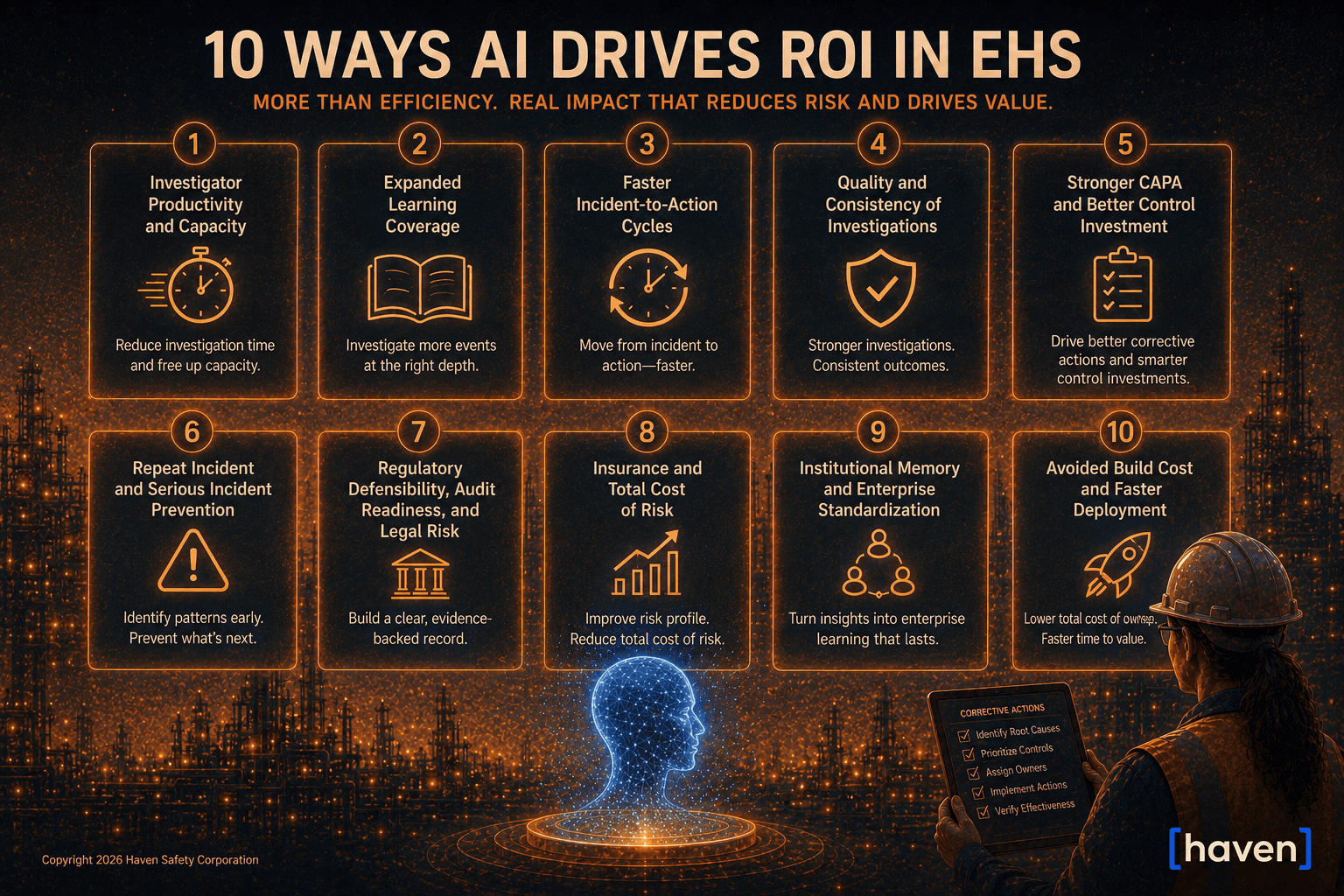

Experience how AI-powered safety intelligence can transform your workplace. Book a demo to see our platform in action.